
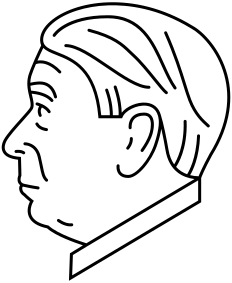


Pauliina Turakka Purhonen (b. 1971)
Amos
2025
textile
Read the letter to Amos Anderson by the artist Pauliina Turakka Purhonen. She read it on the unveiling of the sculpture September 2nd 2025.


Amos!
I have felt your hesitant gaze for a couple of years. I did tell you at the outset that I didn’t have the strength to take you on, not when my brother was taken ill, nor later, when he had just died. But you kept waiting impatiently, you gave me no peace.
Sometimes I’d wake up in the night and feel you staring at me. Immediately you turned your head away and pretended like nothing happened.
You tell me nothing about yourself, yet you demand that I know how to proceed. How do you think that will work?
Don’t you know that it takes two to tango – that there is, or at least should be, some sort of relationship between the sitter and the artist? How am I to create an image of someone who doesn’t want to share his world?
In almost every photo you appear reserved, shut tight like a clam, almost hostile.
Sometimes I think you look like I did in my secondary school photos. Back then, I was on my guard all the time, never knowing what insult would be hurled at me next. Bloody saint. Bloody vicar’s brat. Finn bastard. Sometimes they’d kick me, once I was spat in the face.
What happened to you?
Did you feel threatened?
Or did you just dislike being photographed?
I hated school photo shoots, the photographer trying to coax a tense teenager to smile on cue. And yet I always hoped the pictures would turn out well. They never did. I looked scruffy, sullen and buttoned up.
I’m looking at a photo from the early 60s. You’re happy and relaxed, sitting among friends in a boat. What are you talking about? Maybe that’s doesn’t matter, what’s important is that the sun is shining and you feel safe.
I have been to your house in the country. It’s quite grand, a real palace. But your bedroom is just a simple little chamber, with a narrow bed. Did you build the house for yourself or for your guests? Did you want to show that you could do it, and also afford it?
Or maybe both?
I read somewhere that you were very young when you decided to become rich. That sounds completely daft to me. But actually it’s no more surprising than my childhood decision to become an artist. I remember a crisp autumn evening, it must have been in the early 80s when I was 12 or 13. I was walking home from a school party where I hadn’t danced with anybody because no one had asked me and I was too shy to ask myself. Looking up at the stars, I thought: I’ll show you one day, I’m going to be a famous artist and you’ll read about me in the papers. Ha!
It was nice to be making pictures, of course, and it still is, but in the beginning there was also a real need to prove myself, to show what I could do.
It took a long time before I felt at ease among colleagues. It’s not easy to relax when you’ve learned to be always on guard. But it’s cool now, and I can tell you, Amos, it feels bloody wonderful. Sure, there are individuals in the business who give me the creeps, but there are also lots of funny and deeply humane people.
I don’t know many people in your line of work. Like most artists, I forget at once what people do for a living unless it’s something interesting, like art. Or music. Or maybe theatre. Or something concrete, like being a farmer, or sailor or cook. Once at a wedding, the groom told me I’d asked at least three times what he does for a living. I still can’t remember what it was. He was not in the newspaper business, and certainly not an artist. Artists have a one track mind.
I have painted a few portraits on commission. It’s been interesting, because I would never otherwise have talked with those older men in suits. Would hardly have gotten to know them at all. Some were more open than others, but there were moments of intimacy with all of them. Walks in a shared landscape.
It’s possible that the shared landscape is pure fantasy – but so are most things is life. We live in a partly invented world. None of us knows what someone else’s reality looks like. Not even siblings remember their childhood in the same way.
Reality is so complicated and dense. So much of it is woven into language. What we talk about, that’s what we see. They say that images are a language. For the most part, working with images is a process of solitary deliberation, like this letter. An image has one or several recipients, and the process involves an intense dialogue with them. It may sound odd, but when the work gets going I’m never by myself. Like now, it’s not you alone, Amos, that I’ve been talking with, there are many others involved as well, some of whom have also sat for a portrait. Even Ann-Sofi, the one who spat in my face, she’s here too.
I think about your house, Söderlångvik, in my mind I walk through the rooms. You have seen the palaces of Europe. I have only seen a couple, Versailles and Palazzo Pitti in Florence. The remarkable thing is that the old vicarages I grew up in are like your Söderlångvik. The rooms are all en suite, in a row, with double doors between. If you open all the doors at once, you can see from one end of the building to the other – at Versailles and at Brändö vicarage.
Söderlångvik is not built to be cosy and home-like, but an open stage, a place to see and be seen. I think you built your house for big parties, to facilitate smooth socialising. You liked being on stage, with theatre people. I grew up on a stage and I’m very happy to be free of it and live entirely privately.

The marvellous thing about Söderlångvik is its setting, how naturally the grand entrance, fountain and central corridor with terraced stairs merge into the shoreline, sea and island nature. The house doesn’t disrupt its milieu, it sits there as naturally as a princess cake on a picnic cloth.
If I were as rich as you and could build whatever I wanted, I wouldn’t build a vicarage or a palace. I’d build a studio, with generous doors and high ceiling, six meters at least. And a small flat next to it, with a kitchen and bedroom. But the guests who stay over after our parties are not presidents or dignitaries. They don’t need bedrooms, just a stack of extra mattresses from the cupboard.
I wanted to include your house in the portrait, because I know almost nothing about you as a person. I’ve read up, I’ve tried to get a sense of who I’m dealing with, but someone else has made the original choice, edited your life. That’s not what you have chosen to tell. What matters is what someone chooses to tell me – that’s the image I hear, and the other image behind the chosen narrative, the one I intuit, that’s the starting point for a successful portrait.
To me the house mirrors you and what you wanted to be. It is pompous, to be sure, but also forthright. It is built with a genuine desire to express what you are. Your love of Italian architecture, of art, of theatre and parties, and of your childhood landscape. All this you wanted to show to your guests. Today of course all traces of living and partying have been cleared away, and the paintings on the walls might not be hung by you, but your life and your parties remain there as echoes.
Don’t know why I complained – after all, we have quite a lot in common. Art, first and foremost. I collect art whenever I can, and I spend most of my waking hours thinking about pictures, mine and other people’s.
You were a believer, inclined towards Catholicism. I grew up with images that gave you comfort. Images also gave me comfort during the worst time, in secondary school. I had a job as a church janitor then, and vacuumed the church in the evenings. I had the place all to myself and was free to stand and stare as long as I liked. The church in Finström is filled with images, from floor to ceiling. I was particularly drawn to a battered Man of Sorrows, a small medieval wooden sculpture. His eyes are completely worn away, and most of the paint on his body too. Yet I felt that he saw me. Perhaps all the generations who had come there with their sorrows have left their mark on the little image of Christ, making grief and consolation a tangible presence in the space.
Now my version of him stands in your chapel.
I have explored my visual heritage in many works, but I can never seem to finish with it. It resurfaces in new forms just when I think I’ve found something completely different to do.
Are we ever done with our childhood?
You have a portrait of your mother standing on your bedside table. I seem to remember that you said she was unstable. My mother was too, she was turbulent, to put it mildly. In my teens, I made Madonnas by sewing. Later I was far too angry for that. And I’d certainly never have my mother’s portrait standing anywhere. But I have sewn her, more than once. After her death, I have felt a kind of tenderness, sorrow, but also gratitude.
Kaj wondered how your faith and your sexuality could coexist. That’s something I have thought about a lot too. My own faith has always been a bit so-so – they say cobbler’s children have no shoes – but sexuality can be wild at times, and it hasn’t always gone strictly by the church manual. You lived in a more rigid era, so some things didn’t even go by the legal manual. What can you do? Life is life, and love is love, and where there’s friction, that’s where faith comes in. That’s what I think. Respectability is only half the story. It’s the shadows that make us visible, and we are whole only with the inclusion of things that do not fit the picture, our own picture and that of the outside world.
When I began your portrait, I was unable to make eye contact with you. Your eyes avoided me – or perhaps I shied away from you. Not by force, I thought, you don’t have to look at me.
Yet you seemed to be looking at something. You’re no clam, you’re just turned towards something other than the photographer, than the portrait painter.
I got the clam from a Vietnamese joint in Kallio. It was a cold day in early summer, I was barefoot and shivering. I ordered a pho soup. When the waiter brought the soup, I saw the clam right away. It was stood at the top of the bowl, shimmering mother-of-pearl. I took it with me to the studio, just in case.
Had no plans for it, it was just beautiful, a “bliss thing”, as Astrid Lindgren’s Mardie would say.

The clam developed into a Shrine Madonna. The Shrine Madonna is a version of the Virgin of Mercy, a motif that became common in the Western Church in the late Middle Ages. It is an image of the Madonna who has gathered the congregation under her cloak, protecting them from sorrow, disease, and war, but also from the just wrath of the angels and God.
As a motif, the Shrine Madonna is more complicated – it can be opened and closed, and she contains everything: the congregation, the donor, God’s throne, the universe. It is an explanation of the entire world in a uniquely compact form.
The little Madonna would not have come into being had your gaze not been so intensely focused on something else. What it is you’re looking at? Into yourself, into another world? The Madonna was entirely unplanned, a gift. She is your gift to me, but also my gift to you.
Take care, wherever you are, and thank you!
